Ph.D. application date has been extended till 10th May, 2026. More Details Online Programmes Click here Open House -2026 Click here

Ph.D. application date has been extended till 10th May, 2026. More Details Online Programmes Click here Open House -2026 Click here







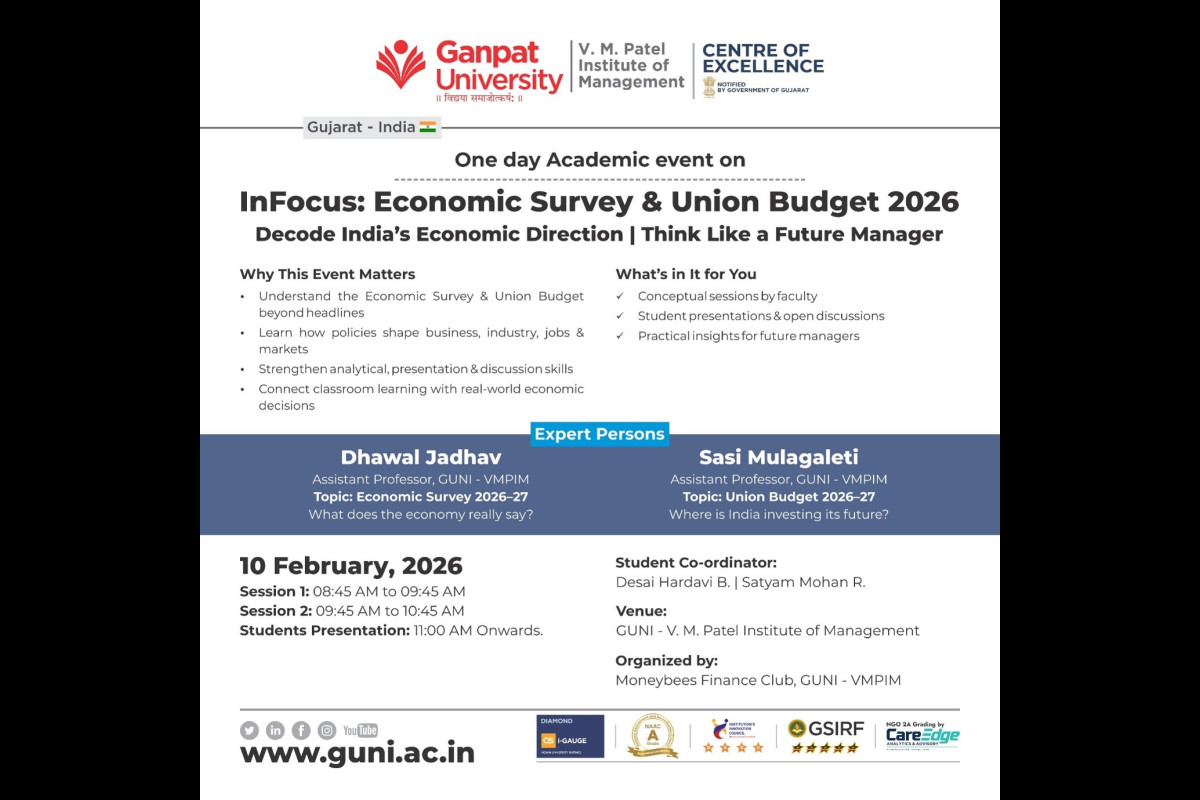
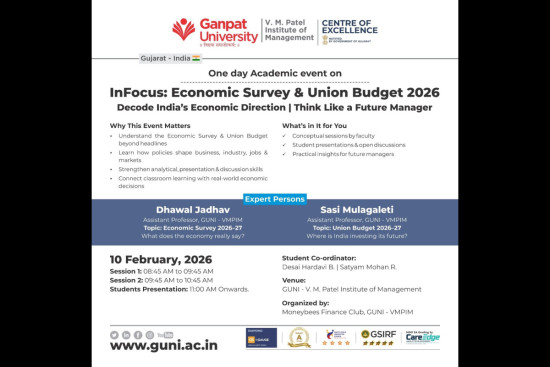
One-day Academic event on InFocus: Economic Survey & Union Budget 2026 Decode India’s Economic Direction | Think Like a Future Manager
Organizers |
Faculty of Management Studies |
Participants |
140 |
Contact No. |
|
Start Date |
10/03/2026 08:30 AM |
End Date |
10/03/2026 05:30 PM |
Venue |
GUNI-VMPIM SEMINAR HALL |
Social Media Share |
Description
In the site of Union Budget-2026-27 presented by India’s Finance Minister Ms. Nirmala Sitharaman in the parliament we at V.M.Patel Institute Of Management hosted one day academic event titled as InFocus: Economic Survey & Union Budget 2026 Decode India’s Economic Direction | Think Like a Future Manager. Academic event started with comprehensive academic session was conducted on the topic Economic Survey of India 2026-27, what does economy really say and its Role in Decision-Making by Prof. Dhawal Jadhav. The session aimed to provide participants with a deeper understanding of the Economic Survey as not merely a statistical document, but as a strategic and analytical framework guiding national and corporate decisions.
The session began with an introduction to the Economic Survey of India, highlighting its historical evolution since its first publication in 1950–51. Participants were informed about its preparation by the Ministry of Finance and its presentation in Parliament prior to the Union Budget. The discussion emphasized how the Survey has transformed over the years—from a descriptive economic review to a forward-looking, policy-oriented document that evaluates macroeconomic performance and suggests reform directions.

A significant portion of the session focused on explaining why the Economic Survey is prepared and how it serves as the intellectual foundation for the Union Budget. It was highlighted that while the Budget allocates financial resources, the Economic Survey provides the diagnosis and analytical reasoning behind economic priorities. The speaker explained the Survey’s role in assessing GDP trends, inflation, fiscal deficit, employment conditions, sectoral growth, and global economic risks.
The core theme of the session revolved around the decision-making relevance of the Economic Survey. At the government level, it assists policymakers in evidence-based decision-making, enabling them to prioritize reforms, manage fiscal policy, and respond to macroeconomic challenges. The Survey was described as a tool that reduces uncertainty by converting economic data into actionable insights.
The session also extended the discussion to the corporate and managerial perspective. It was explained that business leaders use insights from the Economic Survey for strategic planning, investment decisions, risk management, and expansion strategies. By understanding economic trends and policy directions, corporates can align their decisions with national growth priorities and global economic conditions.
Further, the importance of the Survey in budget allocation, risk assessment, and long-term development planning was elaborated. The session emphasized that the document supports scenario planning and highlights emerging risks such as global instability, inflationary pressures, and structural reforms. Participants were encouraged to view the Economic Survey as a bridge between economic analysis and practical decision-making.
The session concluded with the key takeaway that the Economic Survey is not merely a yearly publication but a strategic instrument that informs policy formulation, corporate strategy, and institutional planning. It plays a crucial role in ensuring transparency, accountability, and evidence-based governance.
Overall, the session enhanced participants’ understanding of the Economic Survey’s significance in shaping economic direction and informed decision-making at multiple levels.
Following Economic survey, event continued with session on Union Budget 2026-27 and where is India focusing its investments in future by Prof. Sasi Mulagaleti. It followed as such that the Union Budget 2026–27 presents the Government of India’s fiscal and policy roadmap aimed at sustaining economic growth while ensuring inclusion, innovation, and macroeconomic stability. Prepared in accordance with Article 112 of the Constitution, the budget builds on India’s evolving fiscal framework since Independence and reflects continued reforms such as unified budgeting and outcome-oriented public spending.

Gallery