Ph.D. application date has been extended till 10th May, 2026. More Details Online Programmes Click here Open House -2026 Click here

Ph.D. application date has been extended till 10th May, 2026. More Details Online Programmes Click here Open House -2026 Click here






Visit to Indroda Nature Park (Geer Foundation)
Organizers |
Faculty of Management Studies |
Participants |
43 |
Contact No. |
|
Start Date |
22/05/2026 08:30 AM |
End Date |
22/04/2026 03:20 PM |
Venue |
Indroda Nature Park, Gandhinagaq, Gujarat382007 |
Social Media Share |
Description
Introduction
On 22nd April2026, we, the MBA Sem -ll students of V M Patel Institute of Management. Ganpat
University, visited Indroda National Park as part of a Sustainable Environment Education initiative
associated with GEER Foundation.
The visit coincided with environmental awareness activities, u,hich made the experience more
meaningful. It provided us with a practical understanding of sustainability, conservation, and how
structured management plays a role even in ecological systems.
2lPage
RARK i
!.,,.-661g!4{6'. tf""qitsr*tGr &-
@
m
2. First Impression & Environment
As we entered the park, the most noticeable aspect was the green, calm, and well-maintained
environnrent. The presence ofdense trees, natural shade, and organized pathways created a peaceful
learning atmosphere.
During the group interaction session, we experienced learning in an open natural setting rather than a
classroom. This reflected an important lesson fbr us-that learning environments can be designed
creatively to improve engagement. 3. Interactive Learning Session (Based on Live Demonstration)
3lPag*
h;#
, 1
'.,,,,1
One of the most significant components of the visit was the live demonstration session conducted by an
environmental guide using a world map display. The session rvas designed to provide practical insights
into environmental concepts through visual and interactive methods.
Observations
Durirrg tlre session, it was observecl that the guide effectively utilized visual aids. particularly a map
board, to explain complex environmental concepts in a simplified manner. The interactive nature of the
session encouraged active participation. wherein students engaged by listening attentively and raising
relevant questions. Additionally. the session was conducted in an open garden environment. which
enhanced the overall learning experience by creating a more engaging and less formal setting.
4lPage
I
i
I:
&s*q-qlT"t**r*^ fi{r|(lt 1
t
l , ffi L
j
I
,l
I
I T [}l
Learning Outcomes
The session highlighted the effectiveness of experiential learning techniques in comparison to traditional
classroonr-based teaching nrethods. It also emphasized the critical role of communication skills in
conveyirrg conrplex information in a clear and understandable r11anner. Furthermore, the session
provided insights into how training and development practices are not limited to corporate environments
but can be efTectively applied in diverse fields such as environmental education and awareness.
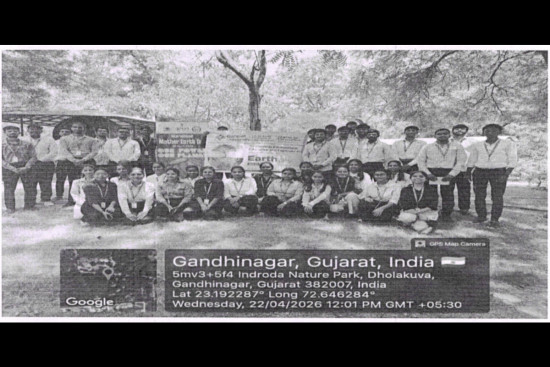
4. MBA Students during Environmental Awareness Visit at Indroda Nature Park
This photograph captures the students participating in an environmental awareness initiative organized
during the visit. The presence of banners related to Mother Earth Day highlights the importance of
sustainability and collective responsibility towards nature.
From a nlanagement perspective, we observed effective event planning, team coordination, and the role
of educational institutions in promoting environmental awareness.
Gandhinagar, Gujarat, India r 5mv3+5f4 lndroda Nature Park, t)holakuva,
Gandhinagar, cujar€t 3B2O0Z lndia
Lat 23.192287o Long 72.646284.
1/ednesday, 221A4/2.026 12:O1 PM GM-f -t.O5:3O
't
t
\d
I
I
1
I I E \l
..,5 T
lfr cFe ur;r camer*
I l*
5lPage
I
5. Interactive Learning Session conducted by Environmental Expert
This session helped us understand environmental concepts through real-life interaction ratlrer than
theoreticalteaching. It also highlighted the importance of communication skills and effective
presentation techniques in knowledge sharing.
6. Wildlife Awareness Display promoting Human-Animal Coexistence
6lPage
&
Gan<J a
Sffivii+5f4
L{rt
frl\.i. GwiT +{}S:3(}
Filad*Aq qEffidLrs ll1, t".. {t,t Itr)l,rilrirr_, itLlartr
i:':ari- I l (!:;}
c.l L i,Fe
\N i I etkl.!.< ; :;Fr
E
'l'hrough this display, we understood the importance of maintaining balance between humans and
wildlife. The use of visuals and creative presentation demonstrated how awareness campaigns can
irtfluence publ ic behaviour.
7. Student Participation and Engagement during the Visit
During the visit, active participation was observed across all activities, reflecting a high level of
discipline, teamwork, and professional conduct among the students. The engagement in various learning
exercises and interactive sessions contributed to a collaborative and structured learning environment.
Learning Outcomes
Such experientialexposure played a significant role in the development of essentialsoft skills, including
communication, observation, and coordination. These competencies are critical for management
TlPage
-rti*il,
tl! )
roeu
Sl crs uap camerd
Gandhinagal Gujarat, lndia 5mv3+5f4 lndroda Nature Park, Dholakuva, Gandhinagal Gujarat 383007, lndia
Lat 23J92264" Long 72.646717"
2210412A2612:A4 PM GMT +05:30
t.
t'
iI
prof-essionals, as they enlrance interpersonal effectiveness and facilitate better decision-nraking and
teamwork in organizational settings.
8. Key Takeaways
The visit provided valuable insights that extended beyond theoretical learning and contributed
significantly to practical understanding. It was observed that learning in an outdoor and experiential
setting enhances comprehension and retention, making it more impactful than conventional classroombased approaches.
The experience also reinforced the understanding that sustainability is not merely a conceptual
framework but a collective responsibility that requires active participation and awareness. Furthermore,
the visit highlighted the critical role of effective communication and presentation in disseminating
information and influencing public awareness on environmental issues. 8l
l-1
I
ffi*-
'::Fr., i;ff*w
it:,rAl: 4:!ni il L
9. Conclusion
The visit to Indroda Nature Park. along with the exposure to activities associated with the Geer
Foundation. proved to be highly enriching and insightful. The experience provided a valuable
opportunity to bridge the gap between theoretical knowledge and practicalapplication, particularly in
the context of sustainability and environmental management.
Furthermore, the visit reinforced the significance of integrating sustainable practices within management
principles. Such experiential learning initiatives play a vitalrole in developing a sense of responsibility
and arvareness among students, thereby contributing to the formation of competent and socially
responsible future managers
Gallery